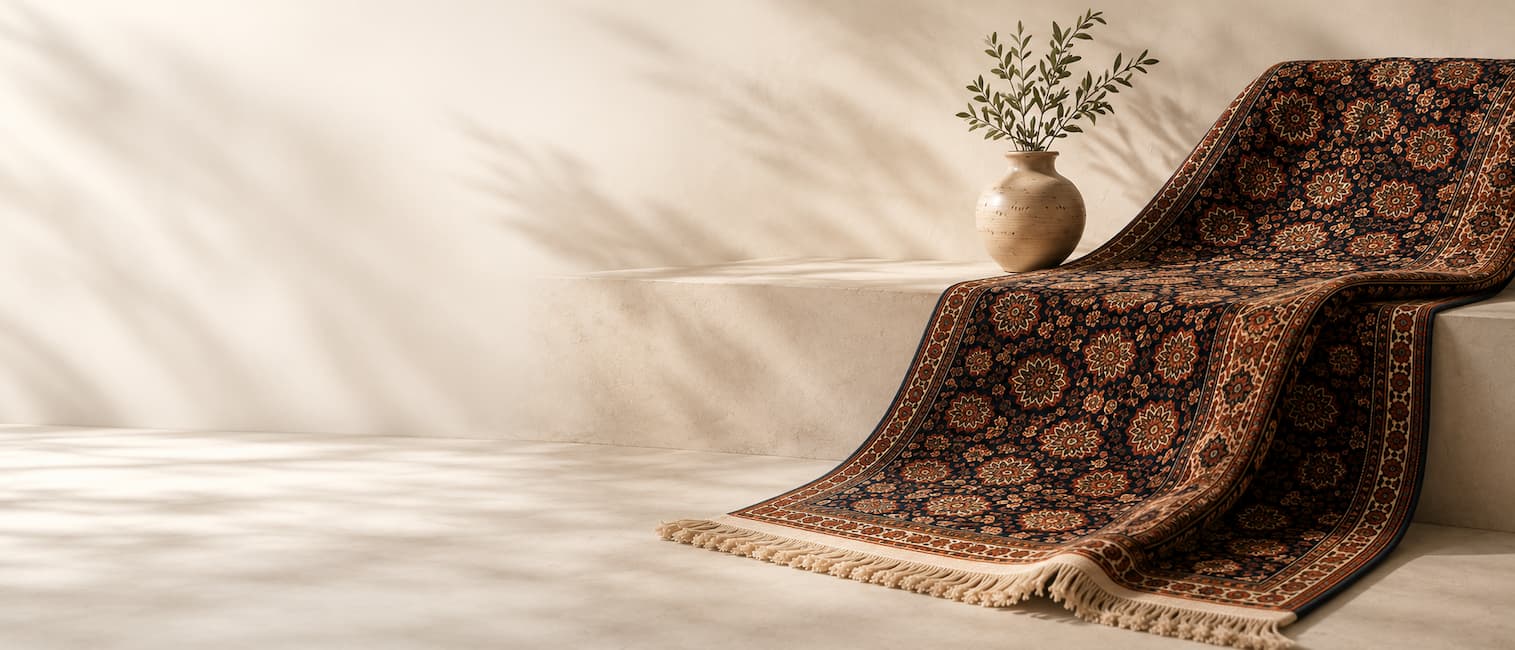
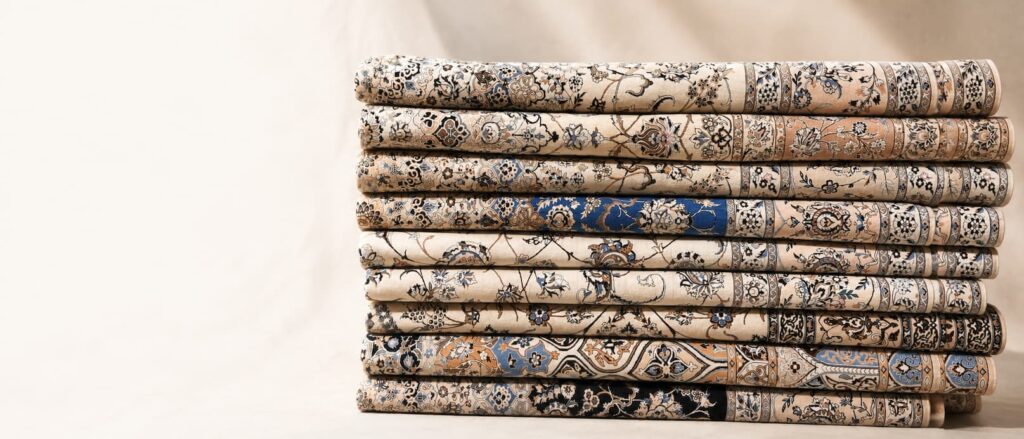
Kashan rugs are among the most recognisable styles of Persian handmade rugs. For many people, the classic image of a Persian rug — a central medallion, elegant floral motifs, deep red and navy colours, and a carefully structured border — is closely associated with Kashan.
But a Kashan rug is more than a particular pattern or colour combination.
Over the centuries, Kashan has produced rugs in different qualities, sizes, designs and periods. Some are commercial workshop pieces, while others are finely woven vintage, antique or collector-quality rugs.
So when we talk about a Persian Kashan rug, it is important to look beyond the city name and understand the rug itself.
What You’ll Learn in This Guide
- Where Kashan rugs come from
- Why Kashan became an important Persian rug centre
- How Kashan rugs are traditionally made
- The most recognisable Kashan designs and colours
- How to evaluate the quality of a Kashan rug
- What to look for before buying one
⸻
A Brief History of Kashan Rugs
Kashan is a historic city in central Iran with a long tradition of textile production and craftsmanship.
Kashan became particularly important during the Safavid period, when the city developed into one of the important centres of fine textiles and court carpet production.
According to the Kashan Cultural Heritage, Handicrafts and Tourism Department, some of the earliest carpets associated with Kashan date back to around the 11th century AH. The city’s carpet tradition went through periods of decline and revival, but continued to develop through later periods. (میراث کاشان)
The importance of Kashan’s weaving tradition is recognised internationally. In 2010, the Traditional Skills of Carpet Weaving in Kashan were inscribed on UNESCO’s Representative List of the Intangible Cultural Heritage of Humanity. (UNESCO ICH)
Kashan remains an active centre of handmade carpet production today. However, modern Kashan rugs vary considerably in quality, from commercial workshop production to finer pieces with more sophisticated materials and craftsmanship.
⸻
How Is a Kashan Rug Made?
One of the traditional characteristics of Kashan weaving is the use of the Persian or asymmetrical knot.
The structure of these knots can be clearly seen on the back of a well-made rug. UNESCO specifically notes the exceptional delicacy of Persian knotting in Kashan and the fine, regular appearance of the knots on the reverse. (UNESCO ICH)
Depending on the rug, the warp and weft may be made from cotton or silk, while the pile may be wool or silk.
This is important because not every Kashan rug uses exactly the same materials. The construction of each individual rug needs to be examined rather than assuming that every rug carrying the Kashan name has the same specifications.
⸻
Popular Kashan Rug Designs
The central medallion is probably the most recognisable Kashan design.
A large central medallion is often surrounded by corner motifs, floral details and scrolling vines. However, Kashan weaving includes a much broader design vocabulary.
Medallion and Corner Design
The classic Kashan composition features a central medallion with four corner motifs, creating a balanced and symmetrical structure.
Afshan
In an Afshan design, flowers, leaves and vines spread throughout the field rather than being organised around one dominant central medallion.
Shah Abbasi
Shah Abbasi floral motifs are another important part of Persian urban rug design and appear frequently in Kashan carpets.
Vase and Tree Designs
These designs use vases, flowers or tree motifs as the main visual elements and often create a more decorative and traditional appearance.
Prayer Designs
Prayer or Mihrab compositions are also found among Kashan rugs, particularly in smaller or prayer-sized examples.
The Kashan Cultural Heritage Department lists medallion, prayer, vase and tree, hunting scene, boteh, prayer-rug and other traditional designs among the recognised Kashan carpet patterns. (میراث کاشان)
⸻
Colours of Kashan Rugs
Colour is one of the most distinctive visual characteristics of Kashan rugs.
Traditional examples are often associated with deep red, navy blue and cream or ivory, although many rugs also include shades of blue, green, pink, gold and brown.
Traditional Kashan dyeing has also included natural materials. UNESCO mentions madder root, walnut skin, pomegranate skin and vine leaves among the natural dye sources associated with Kashan carpet weaving. (UNESCO ICH)
However, an important point is often overlooked:
An old rug is not automatically a naturally dyed rug.
The colours of an individual carpet need to be examined for their depth, consistency, ageing, possible abrash and overall condition. Dye quality is one part of a broader assessment of the rug.
⸻
How Do You Evaluate the Quality of a Kashan Rug?
There is no single number that determines the quality of a handmade Kashan rug.
Knot density, wool quality, foundation materials, drawing, dye quality, finishing, structural condition, age and even the way a rug has been maintained can all influence its quality and value.
The back of the rug is one of the first places worth examining.
In a well-made handmade rug, the knot structure should be visible and consistent with the overall construction. But knot count alone does not determine quality.
A higher knot count does not automatically make one rug better than another.
For example, an older Kashan with beautiful drawing, high-quality wool and attractive ageing may have considerably more artistic or historical appeal than a newer rug with a much higher knot density.
The right approach is to evaluate the rug as a whole.
⸻
Are All Kashan Rugs the Same Quality?
No.
This is one of the most important things to understand when buying a Kashan Persian rug.
Kashan is a weaving tradition and geographical origin — it is not a quality grade.
The market today includes a wide range of Kashan rugs, from commercial workshop pieces to finely woven vintage and antique examples.
Two rugs can both be described as Kashan while having completely different materials, construction, age, condition, design quality and market value.
That is why the name “Kashan” should be the beginning of an evaluation, not the end of it.
⸻
Are Kashan Rugs Suitable for Modern Homes?
Yes.
The balanced composition, floral vocabulary and structured borders of Kashan rugs work naturally in traditional and classic interiors, but they can also work surprisingly well in contemporary spaces.
A deep red Kashan with a strong central medallion can become the visual centre of a room, while a lighter-coloured or Afshan Kashan can create a quieter and more relaxed atmosphere.
The right choice depends less on the name “Kashan” and more on the rug’s size, colours, scale, pattern and the room where it will be placed.
⸻
What Should You Check Before Buying a Kashan Rug?
If you are considering buying a handmade Kashan rug, do not rely only on a photograph or the name attached to it.
Consider these points:
- Origin
Does the rug’s construction and description support its claimed Kashan origin? - Handmade construction
The back, knots, edges and structural details should be examined. - Materials
The type and quality of wool, cotton, silk or other fibres should be clear. - Colour condition
Look at colour consistency, ageing, abrash and possible signs of dye-related problems. - Structural condition
Repairs, tears, damaged areas, distortion and previous restoration can affect the value of a rug. - Age
A new, vintage and antique Kashan should not be evaluated using exactly the same criteria. - Design and workmanship
The quality of the drawing, floral details, border proportions and execution are all important.
Most importantly:
The word “Kashan” does not guarantee quality. The rug itself needs to be evaluated.
⸻
Kashan Rugs: A Living Persian Tradition
Kashan rugs are part of a living Persian carpet tradition — one that has developed through historical workshops and classical designs and continues through contemporary production.
What makes an individual Kashan rug special is not simply the name of the city.
It is the combination of design, colour, materials, craftsmanship, age, condition and the character of the individual piece.
So when buying a Kashan rug, instead of asking only:
“Is this a Kashan rug?”
it is more useful to ask:
“What kind of Kashan rug is this, how was it made, what is its condition, and is it the right rug for me?”
If you are considering a Kashan rug and want help evaluating its origin, quality, age, size, colour or value, you can send us its photos and details before making a purchase.